

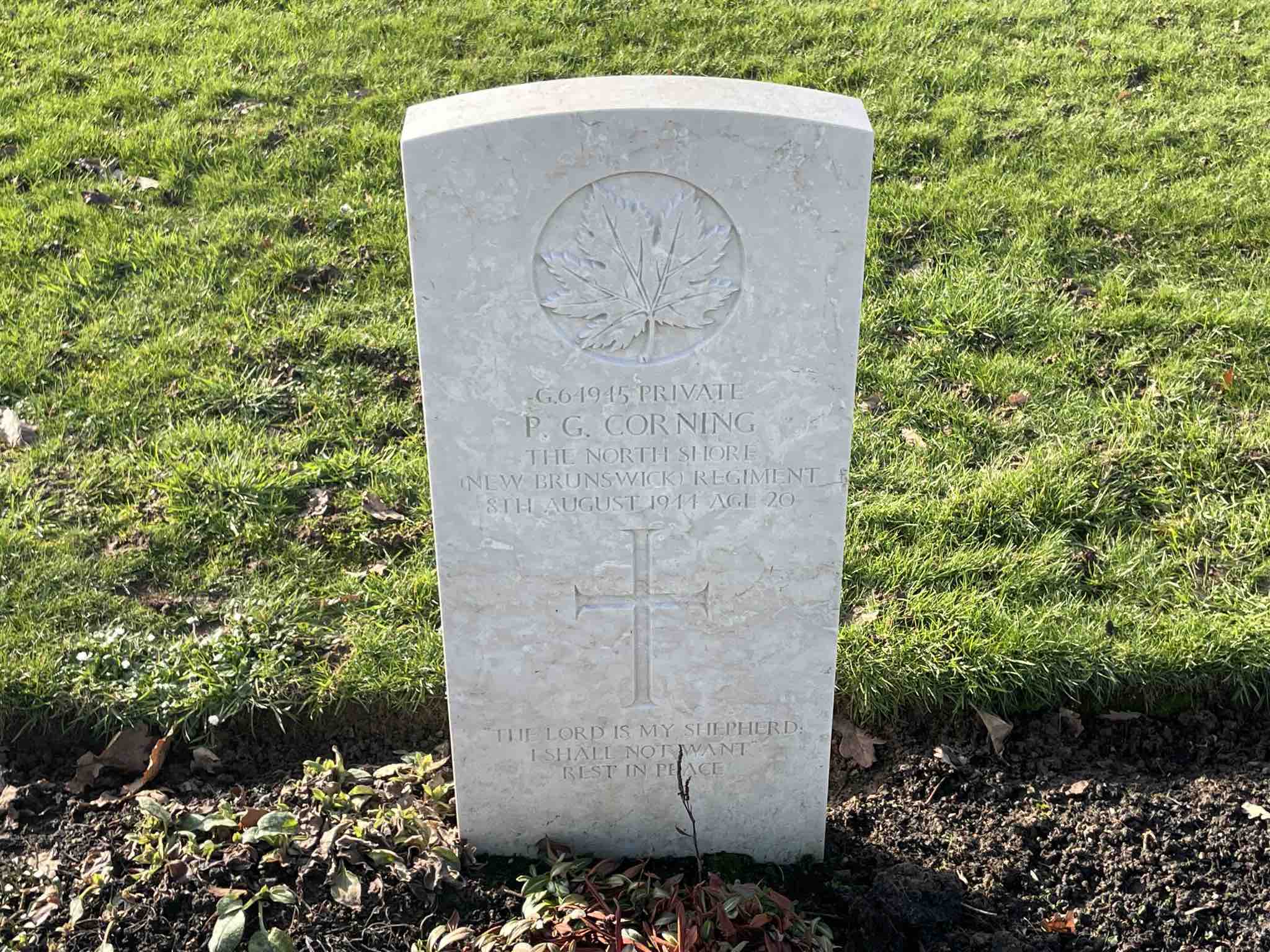
Private Philip Corning G/64945, North Shore (New Brunswick) Regt. - 'Friendly Fire' Casualty, August 1944

- Rank
- Private
- Name
- PHILLIP GEORGE CORNING
- Regiment
- North Shore (New Brunswick) Regiment, R.C.I.C.
- Date of Death
- Died 08 August 1944
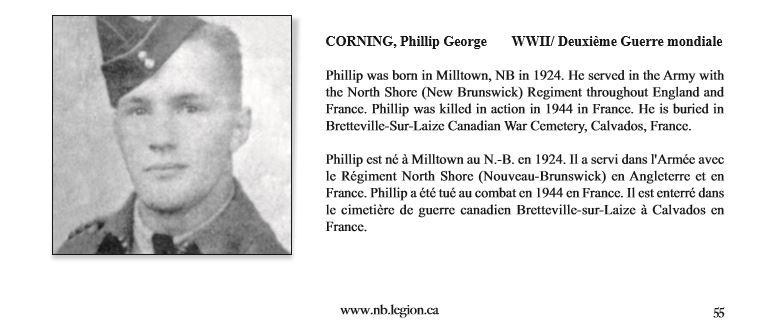
Pte Philip George Corning (Service # G64945) was born on February 22, 1924, in St. Stephen, Charlotte County, New Brunswick. His parents were Ernest Melvine Corning and Jessie Sarah (O’Leary) both from St. Stephen. On their marriage certificate, Ernest stated his occupation as a mechanic. Philip had three brothers Frank, Kenneth, and Webber. Webber died in November 1929. The family attended the Methodist church.
At age sixteen, Philip left school and went to work for Ganong Brothers, a candy maker in St. Stephen. He worked there for three years.
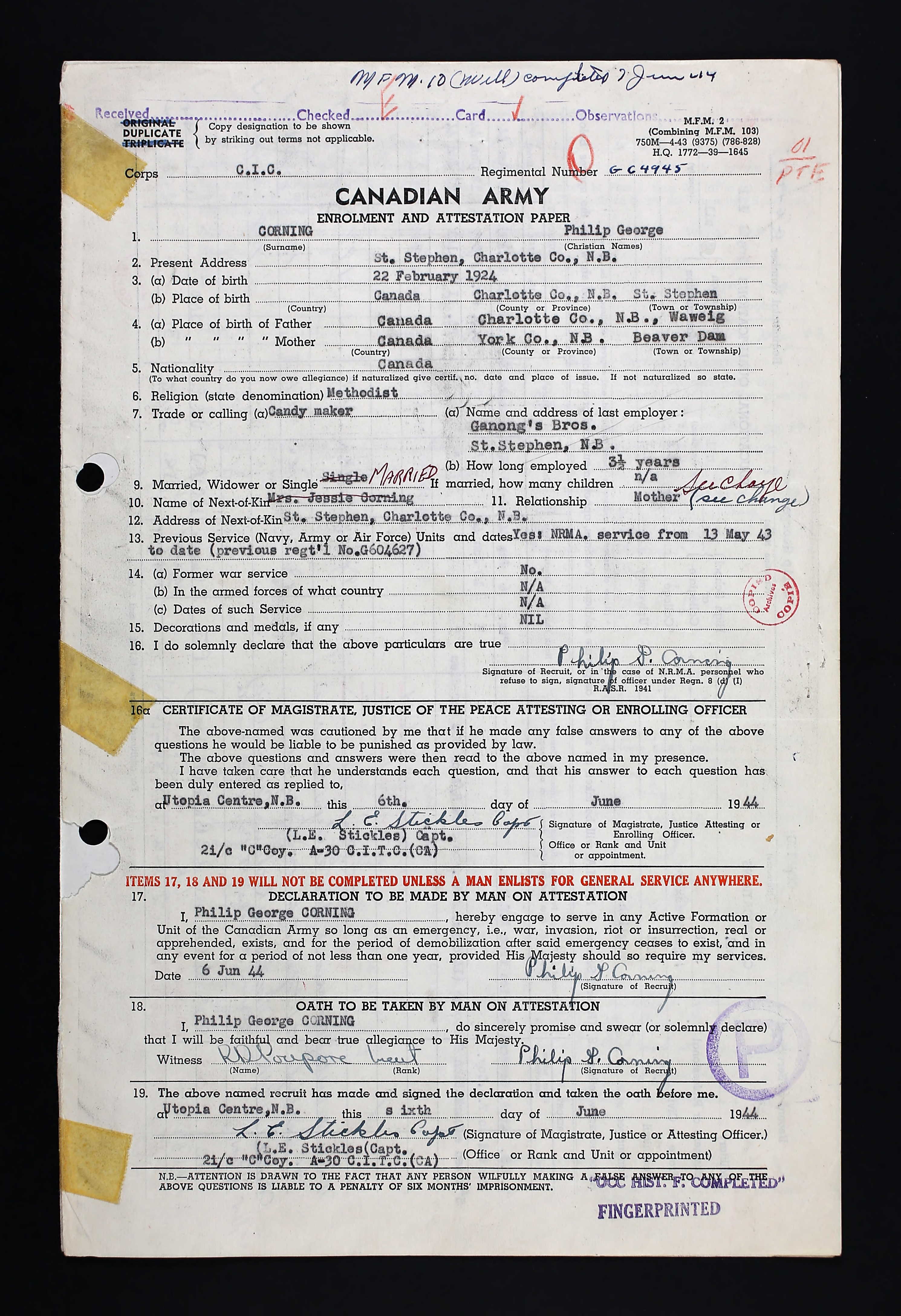
In May 1943, Philip was drafted into the Militia for home defense duty under the new National Resources Mobilization Act (NRMA) that came into effect in 1940. He enlisted at Saint John and began basic training in June at Camp No. 70 at Fredericton. The following April Philip was transferred to the Canadian Infantry Training Centre (CITC) Camp No. A-30 at Utopia. Records show that he was 5’ 6” in height with brown hair and brown eyes, and weighed 142 lbs.
On June 6, 1944, Philip revised his status by enlisting for active duty wherever he might be needed. A new service # G64945 was created. Six days later Philip was given notice that he was going overseas in mid-July. He was then granted an embarkation leave of fourteen days. During this time, Philip and Miss Evelyn Katherine McGarrigle of Milltown, Charlotte County decided to get married. They obtained the necessary military approval and were married on July 8 at St. Andrews Chapel in Utopia Centre.
Four days later Philip sailed for the United Kingdom and on July 19 reported for duty with the Canadian Infantry Reinforcement Unit (CIRU) in England. On August 4, Philip was transferred across the English Channel to France and assigned to the North Shore (New Brunswick) Regiment NS(NB)R. He caught up with the regiment on August 8.
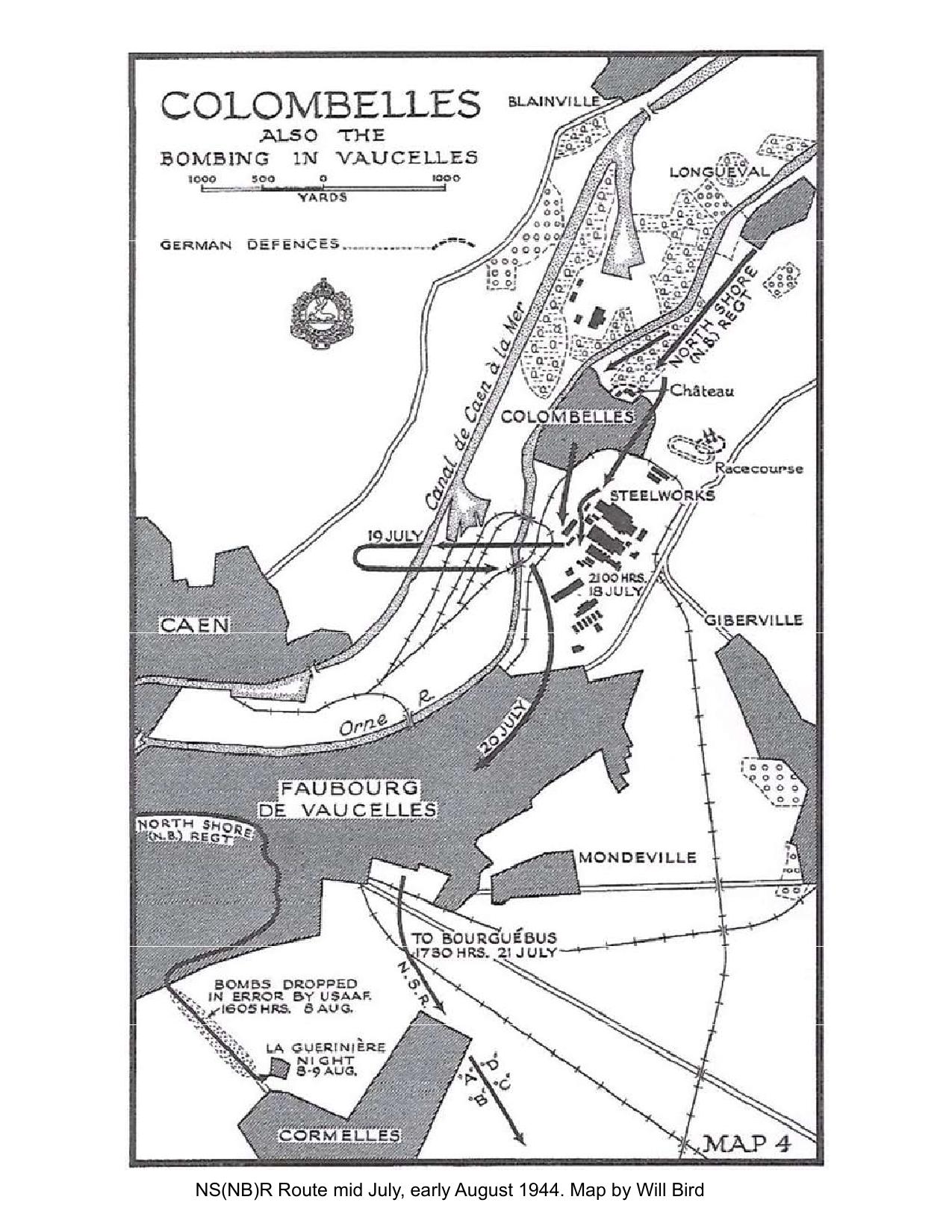
It was now two months since D-Day. The NS(NB)R had fought brutal and costly battles on the perimeter of Caen at Carpiquet, Colombelles, and Bourguébus. On July 30 they were given their first break and withdrew from the front line to Fontaine-Henry for a few days of rest and refit.
On August 8, the War Diary records that the regiment was at Basly and the weather was clear and hot. Reveille was at 0600 hours and at 0700 hours orders were received to be ready to move within an hour. A little before noon the North Shore joined up with a convoy moving south from Caen. They were now part of an Allied force of British, Polish, and Americans, preparing to encircle the German army near Falaise.
At 4:05 p.m., as they approached the village of Cormelles, the regiment saw two squadrons of American Fortress B-17 bombers on the horizon and started cheering. As the bombers moved closer however it was apparent that below them was an advancing wall of fire and smoke, and bombs could be seen falling from the planes. The American squadrons had mistaken the Allied convoy for Germans. Without waiting for orders the men dove for the ditches and under vehicles. Plane after plane swooped down and dropped its bombs. Their targets included fuel trucks, ammunition supplies, and troop carriers. The results were devastating. The valley was now filled with blazing vehicles, the dead, and the wounded. Within minutes 23 North Shore soldiers had been killed and 75 wounded. The casualties included Major General Keller commanding officer of the 3rd Division who was wounded.
Pte Philip George Corning was wounded and died during the friendly fire episode on August 8, 1944. It was his first day on the front line and exactly one month since he was married. He was twenty years of age.
The Allied forces were composed of many armies with multiple divisions. Keeping track of everyone's location was difficult and bombers were, at times, uncertain of their own location and uncertain of the identity of vehicles, troops, and artillery below them. It is also recorded that perhaps because of the congestion in the convoy the NS(NB)R had deviated from the main road and this may have confused the pilots.
For his service to Canada, Pte Philip George Corning was awarded the following medals;1939-45 Star, France & Germany Star, War Medal 1939 -1945, and Canadian Volunteer Service Medal with Clasp.
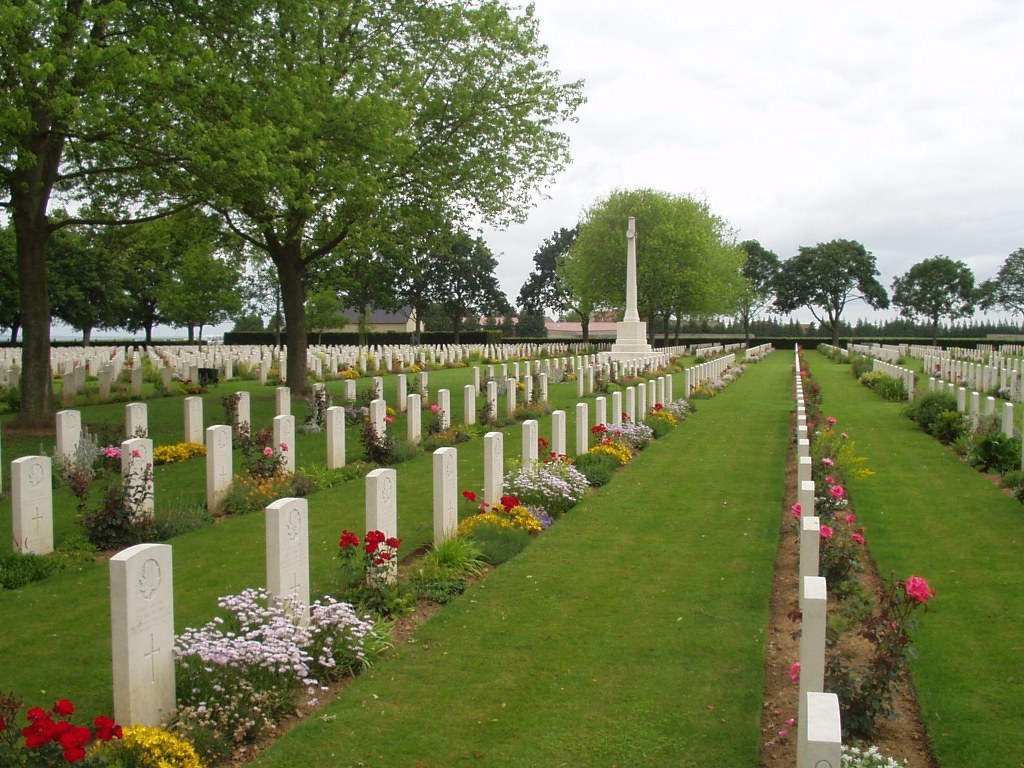
Pte Philip George Corning is buried in Bretteville-sur-Laize Canadian War Cemetery in France. Plot XV. A. 11.
Loading map…

Support the Foundation
By donating to our Charitable Foundation you help us deliver projects like For Evermore, which educate and inspire future generations to remember those who gave their lives in the two World Wars. With your support, we can keep their stories alive and ensure they are never forgotten