

28 September 2026
Three CWGC Memorials, Three Approaches to Commemoration
2027 will mark the centenary of three of our most iconic memorials: The Ypres (Menin Gate) Memorial, the Tyne Cot Memorial, and the Neuve-Chapelle Memorial.
Together, these sites commemorate by name close to 95,000 officers and enlisted men of the First World War with no known war grave.
Our war memorials were originally built to provide places of commemoration for missing casualties; spaces for relatives to see their loved ones’ names and grieve.
But, despite their common purpose, no two Commission war memorials are entirely alike. We can see this through the sites named above.
One is a gateway within a city; one a memorial within a wider cemetery landscape; one whose character reflects a different cultural context.
Join us as we explore commemoration through three individual CWGC memorials to the missing.
At a glance: What makes these memorials different
Memorial | Setting | Relationship with names | Comparative commemorative role |
Ypres (Menin Gate) Memorial | An urban gateway in the heart of a busy city | Names incorporated into the larger monumental structure | Shows how commemoration becomes part of a living city |
Tyne Cot Memorial | Cemetery landscape | Memorial names sit alongside war graves and unidentified burials | Shows how different forms of commemoration can share one place |
Neuve-Chapelle Memorial | Dedicated memorial site | Named commemoration shaped by a distinct cultural context | Shows how those commemorated can influence the character of a memorial |
One purpose, different places
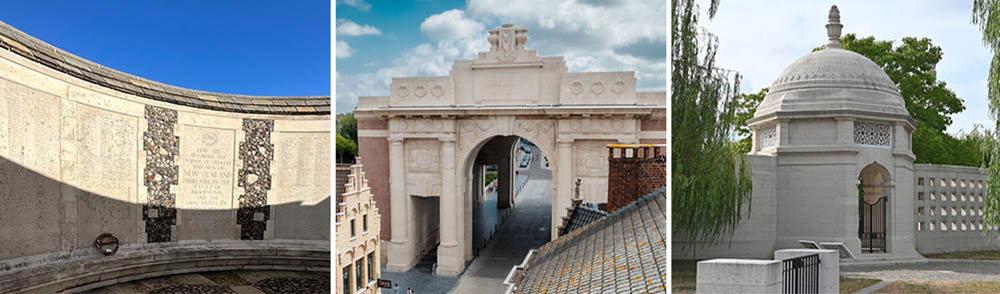 Image: From left to right: The Tyne Cot Memorial, Ypres (Menin Gate) Memorial, and the Neuve-Chapelle Memorial
In the 7th annual report of the commission, Major-General Fabian Ware describes how the war dead:
“Deserved perpetuity in Sepulchre... [that this was] previously reserved for the former ‘great of the earth’, most commonly by burial in some historical or sacred monument such as Westminster Abbey or other cathedrals, [and that] since the war dead could not be brought in their hundreds of thousands beneath the sacred shelter of existing monuments, structures at least as lasting must be erected in distant lands”.
Our war memorials to the missing play an important role in commemoration, providing spaces where the names of those with no known war grave could be displayed and listed forever.
As well as this basic but important role, memorials serve other commemorative functions.
For example, some of our sites double as battle memorials for particular campaigns or actions, as well as points of named commemoration.
The Thiepval Memorial to the Missing of the Somme serves as the battle memorial for the Somme, while commemorating more than 72,000 by name, for example.
Other sites, such as Neuve-Chapelle, act as memorials for wider national service. In Neuve-Chapelle’s case, it is a monument to Indian Army service on the Western Front and a place for named commemoration of Indian servicemen.
Why setting and context matters
Setting, landscape and context affected the design and construction of our memorials. They inform aspects like:
A memorial’s cultural and historic context – Which battles were fought nearby and who fought them?
Landscape – How does a memorial sit within the existing countryside and landscape?
Available space – Is there room on land granted by governments or purchased to build an appropriately sized site?
Surrounding towns or cities – What’s the historic context for a memorial? Is there space within nearby towns and cities?
Number of names – Memorial size is affected by the number of servicemen and women it commemorates
Communities and cultures – How will the design encourage equality in commemoration while being respectful of the Commonwealth’s various cultures and communities
No single model of commemoration
The basic purpose of our war memorials is to commemorate by name servicemen and women with no known war graves.
The aspects listed above meant there was no “one-size-fits-all” approach to war memorial design. Each site had to respond to its purpose, surroundings, and the individuals it commemorates.
Because of this, no two CWGC war memorials are the same, as you’ll see as we investigate the Menin Gate, Neuve-Chapelle, and Tyne Cot Memorials in more detail.
Menin Gate – When Commemoration Becomes Part of a City
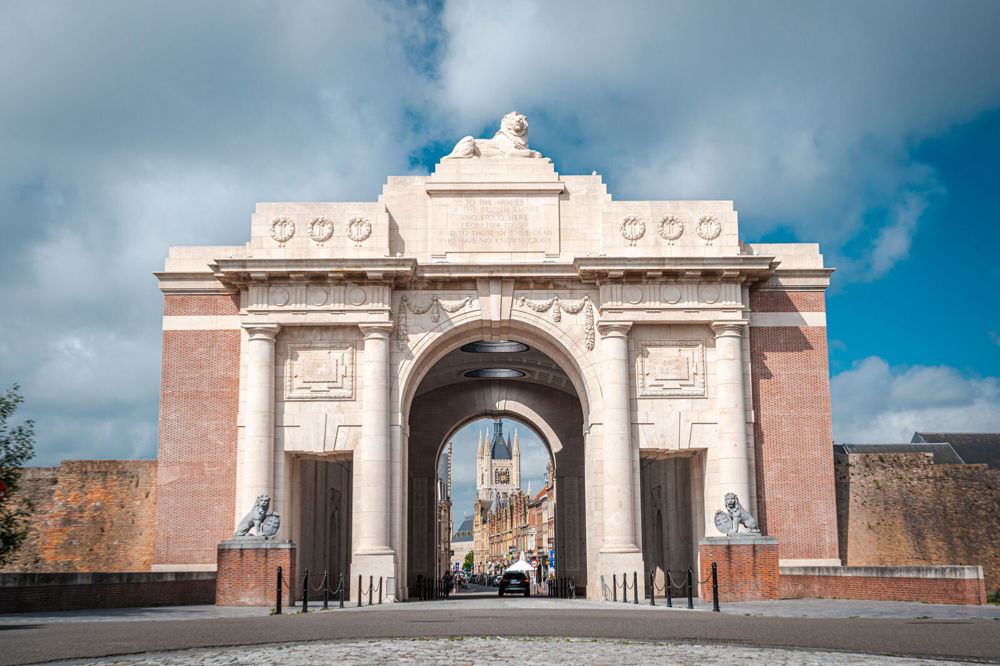 Image: The Ypres (Menin Gate) Memorial is one of the city's most iconic pieces of architecture
The Ypres (Menin Gate) has stood in the heart of Ieper, Belgium, since 1927.
More than 54,000 names of British, Australian, Canadian, Indian, and South African servicemen are commemorated here, men who fought and fell in the Ypres Salient, but whose war graves are not known.
A memorial people pass through
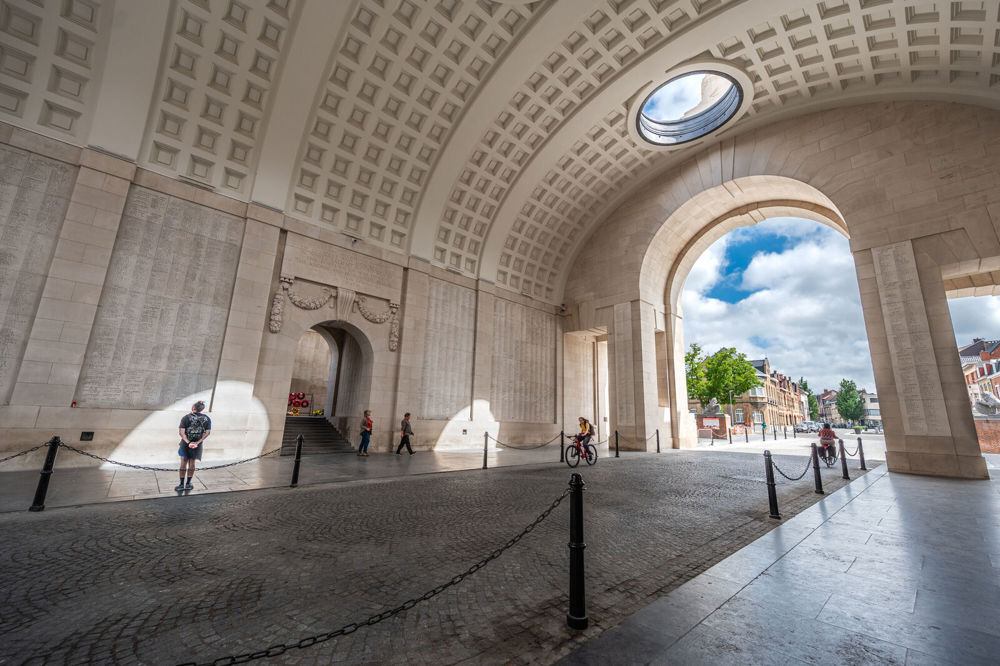 Image: Much like soldiers heading to the front, hundreds of thousands of people pass through the Menin Gate every year
The Ypres (Menin Gate) Memorial is woven into the fabric of Ieper itself, standing over one of the main thoroughfares into the city centre.
Hundreds of thousands of Commonwealth troops marched through the old Menenpoort on their way to the front in the Great War, and that’s what makes it unique.
Some of their names are carved in stone on the memorial’s name panels after marching to the Ypres Salient, never to return.
You can walk the same route as these men, beneath the memorial commemorating their loss, which helps us reflect on their loss. The Menin Gate invites you to walk in their footsteps while contemplating their experiences and sacrifice.
As the Ypres (Menin Gate) Memorial is interwoven into the routes and urban fabric of Ieper itself, it’s a reminder of how the city and the First World War will always be indelibly linked.
A design identity that continues today
 Image: The Menin Gate 100 Mark
As we approach the Menin Gate’s 100th anniversary, we’ve created a new mark to symbolise a century of shared commemoration at the site.
Featuring the memorial’s central triumphal arch and a lion in repose, it captures the Menin Gate’s dignity and enduring significance as part of the UNESCO World Heritage-listed First World War funerary and memorial sites, as well as its deep connection to Ieper's history.
Tyne Cot: When Graves and a Memorial Share the Same Landscape
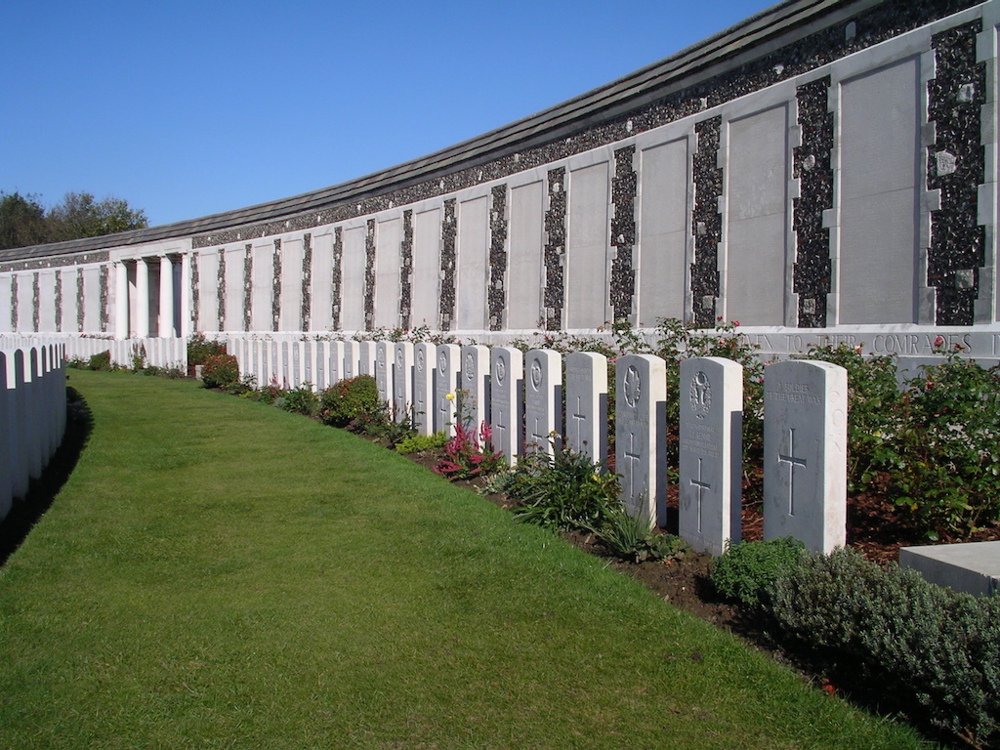 Image: Tyne Cot Memorial forms the rear screen wall of our largest war cemetery in the world
Unlike the Menin Gate, which was built directly into Ieper’s city plan, the Tyne Cot Memorial stands as the boundary wall of Tyne Cot Cemetery.
Names and graves in one place
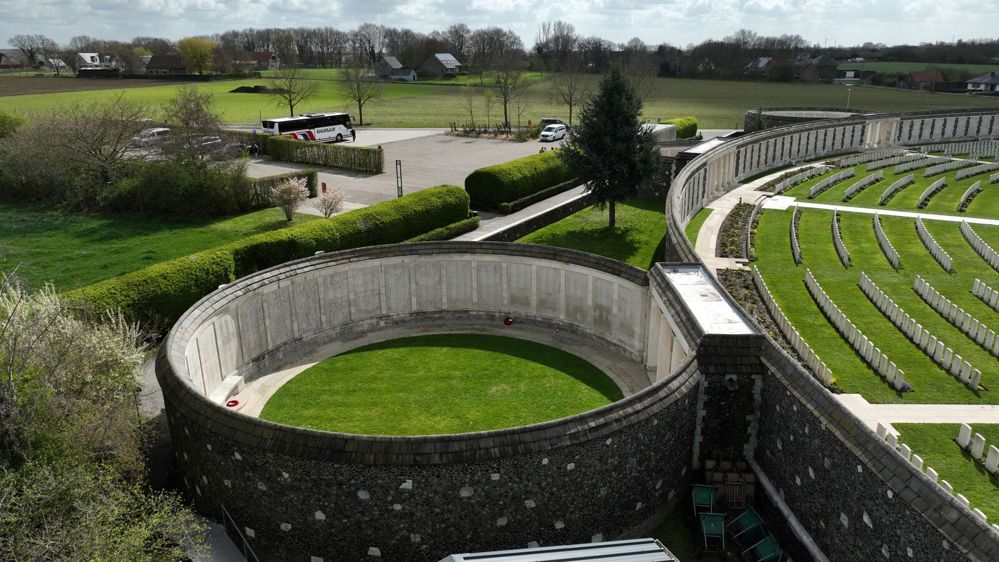 Image: The Tyne Cot Memorial shares its space with over 11,000 headstones
The Tyne Cot Memorial is incorporated within a wider cemetery landscape.
The memorial itself forms Tyne Cot’s rear screen wall, where over 32,000 missing servicemen are commemorated.
Tyne Cot is our largest war cemetery in the world, with approaching close to 12,000 war graves and burials, in addition to those commemorated on the memorial. 8,000 or so of these burials are unidentified.
An interesting contrast is created by the interplay between the war graves and the memorial. Tyne Cot Cemetery is the largest CWGC war cemetery in the world, with thousands of headstones, but this is still dwarfed by the number of names carved into the Tyne Cot Memorial, highlighting the scale of loss at Passchendaele and beyond.
It also invites users to think whether one of the men lying unidentified in a Tyne Cot grave could be commemorated by name just feet away on a memorial name panel.
Visitors move uphill through the cemetery, matching the footsteps of the Australian servicemen who captured the ground in 1917.
As they pass through the site, observing headstone rows and cemetery features, they will come to the Tyne Cot Memorial at the rear of the cemetery.
Not only does it commemorate the names of thousands of missing servicemen, but the memorial also marks the end of the Battle of Passchendaele.
The rear curtain wall represents the extent of the Allied advance at Passchendaele. Together, the graves and memorial name panel highlight the extent of the destruction endured by Commonwealth forces, reinforced by visitors' journeys through the cemetery space.
Neuve-Chapelle: When people commemorated shape the character of a Place
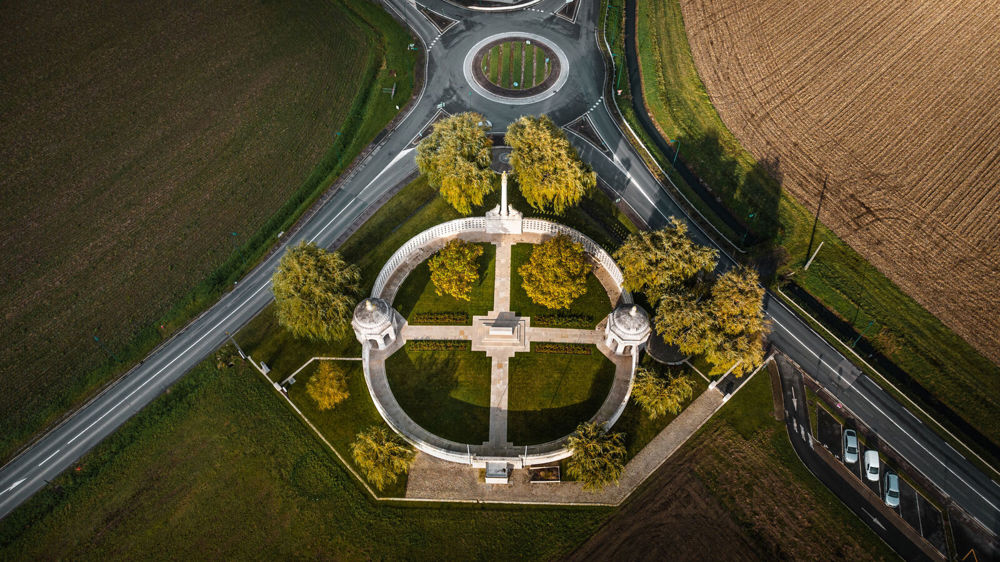 Image: The Neuve-Chapelle Memorial from the air
Half of the 8,000 or so Indian Army servicemen of the First World War who died on the Western Front have no known war grave.
Commemorating these men by name and representing the wider Indian contribution to victory in France and Belgium, the Neuve-Chapelle Memorial was unveiled in 1927.
A different architectural language
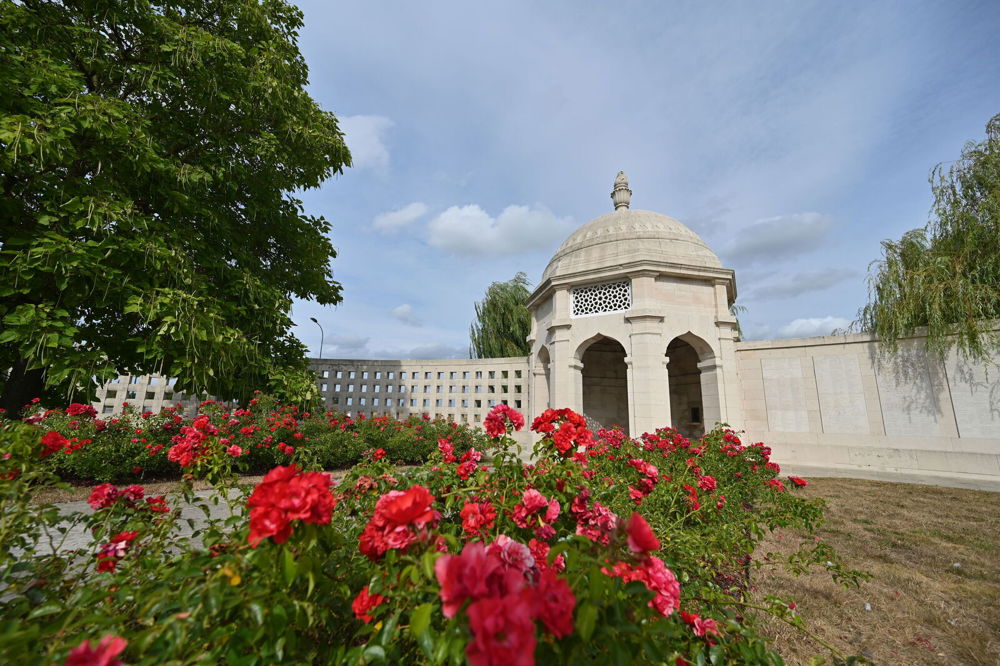 Image: Neuve-Chapelle's architecture was directly influenced by classical Indian monument and funerary architecture
The Neuve-Chapelle Memorial was designed by Sir Herbert Baker, an architect with considerable experience working on colonial projects in India, where he fused classical Western forms with India’s monumental and funerary architecture.
The location of the memorial was specially chosen, as it was at Neuve Chapelle in March 1915 that the Indian Corps fought its first major action as a single unit.
The site is instantly recognisable as an Indian Army site. Baker incorporated elements of Indian architectural design, drawn from temples, forts, and shrines, resulting in a sanctuary-like space that sits in and apart from its Western Front context.
As a CWGC site, built in sturdy Portland Stone, it is clearly a Commission war memorial, but it eschews the design language of Western triumphalism for a more Indian approach.
Identity, recognition and commemoration
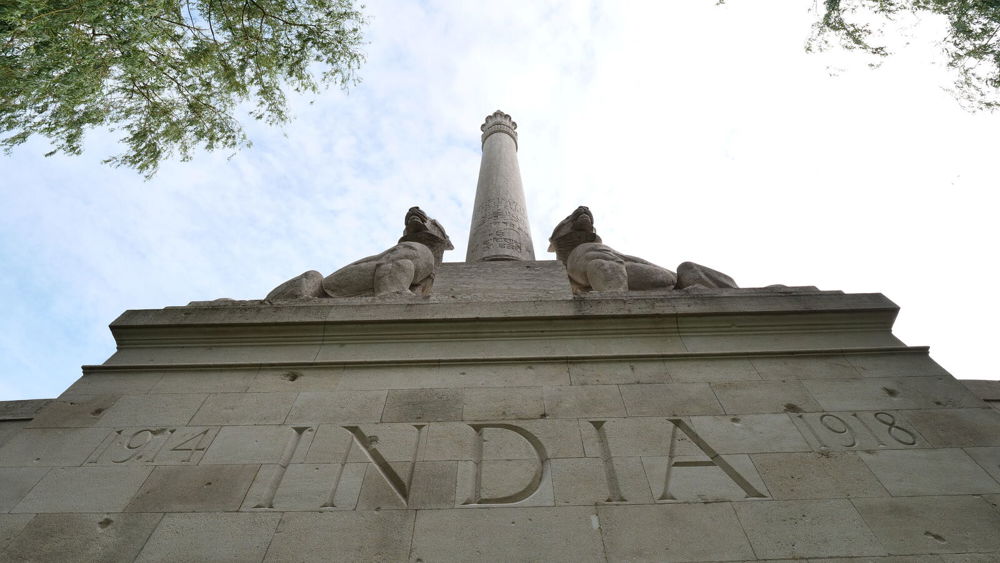 Image: Neuve-Chapelle expresses Indian identity through architecture
The architecture immediately informs visitors that this is a place dedicated not to European, Australian, Canadian, New Zealand, or South African soldiers. This is clearly a place dedicated to the commemoration and memory of India’s war dead.
Here, several thousand miles from home, stands a piece of clearly Indian-inspired architecture, representing those who travelled miles from home, under the auspices of the British Empire, and lost their lives. Now, a small piece of their homeland stands at the site of one of the Indian Army’s most significant actions on the Western Front.

Want more stories like this delivered directly to your inbox? Sign up for our newsletter for regular updates on the work of Commonwealth War Graves, blogs, event news, and more.
Sign UpWhat changes when we look at all three sites together?
So, we have three Western Front sites, each in its own context, driven by different site needs and commemoration requirements.
Place changes the design
Location, location, location. Three important words, but three which drove war memorial design and construction in our earliest days.
Place affects not only how memorials were built, but also how they are experienced. We can see this in the different ways users interact with the Menin Gate and Tyne Cot spaces.
The Menin Gate invites movement and dynamism, asking visitors to pass through the gateway but also to take in the tens of thousands of Commonwealth names adorning its memorial panels on their way through.
Conversely, Tyne Cot still invites movement and a journey through the headstones, but the rear curtain wall suggests a type of finality: the end of the Battle of Passchendaele and the end of these servicemen's lives.
Their locations also highlight different aspects of commemoration. The Menin Gate is a tourist destination and city icon, thanks to its central urban location. Tyne Cot is no less a significant attraction, but its position on the former Passchendaele battlefield provides a different look, feel and experience.
Names change the space
Who a war memorial commemorates, and the number of names thereof, influenced its look, aesthetics, and location.
That’s why the Neuve-Chapelle Memorial looks distinct from Tyne Cot and The Menin Gate.
Tyne Cot, in particular, shows the influence of the “English Country Garden” design philosophy of the CWGC’s early days: a flint curtain wall matched with Portland Stone name panels evokes English churchyards, ideally suited for a place predominantly commemorating those of European descent.
Meanwhile, at Neuve-Chapelle, we can see that the Indian names informed Baker’s work, inspiring the blend of Indian and Western styles which make Neuve-Chapelle visually unique.
Different forms, shared responsibility
Despite their varied forms, locations and contexts, Neuve-Chapelle, Tyne Cot and the Menin Gate are linked by a single through line: commemoration of the Commonwealth’s shared war dead.
Each site performs its primary function: clearly naming the officers and enlisted men lost in the First World War but whose graves are still unknown.
This is the shared responsibility of all our memorials to the missing, even our radically new sites such as the Cape Town Labour Corps Memorial in South Africa.
To see how this responsibility continues today, see how the CWGC is marking 110 years since the Battle of the Somme.
With no set template, our war memorials are all unique but connected by their shared responsibility.
How to explore memorials further
Click the links below to learn more about these three CWGC war memorials.


Author acknowledgements
Alec Malloy is a CWGC Digital Content Executive. He has worked at the Commonwealth War Graves Commission since February 2022. During that time, he has written extensively about the World Wars, including major battles, casualty stories, and the Commission's work commemorating 1.7 million war dead worldwide.
War Memorials FAQs
The design of CWGC war memorials is influenced by:
The people it was to commemorate (regiment, armed forces branch, nationality, etc.,)
Its location and context
How many names it commemorates
CWGC memorials to the missing were designed to reflect the service branch, nationality, and battlefield locations and campaigns of the men and women they commemorate. For example, the naval memorials feature naval sculpture and decorative elements, whereas our air forces memorials are likewise decorated to showcase the service of the Commmonwealth air forces.
Location impacts war memorial design in several ways:
Battlefield or campaign significance - Tyne Cot commemorates missing officers and men who died after 16 August 1917, including men from the final stages of the Battle of Passchendaele. The memorial curtain wall marks the furthest extent of the Allied advance during the battle.
Physical location - The Ypres (Menin Gate) Memorial was chosen to sit in the heart of Ypres, turning it into both a war memorial and a practical
Historical context - Neuve-Chapelle, for example, sits at the site of the Indian Army's most significant Western Front action, doubling as a battle exploits memorial and a memorial to the missing.
Yes, often war memorials were built into the architecture or placed within a cemetery. Examples include the Tyne Cot Memorial within Tyne Cot Cemetery, the Arras Memorial and Arras Air Services Memorial in Faubourg d'Amiens War Cemetery, and the Pozieres Memorial within Pozieres British Cemetery.
Neuve-Chapelle differs from the Menin Gate and Tyne Cot Memorials as it is explicitly a memorial commemorating Indian soldiers who have no known war grave. No other nationalities are commemorated at Neuve-Chapelle. The memorial's architecture features heavy elements of classic Indian temple, monumental and funerary architecture, making it visually clear this is a space dedicated to Indian servicemen.
The names are the key component of our war memorials. Without them, they do not fulfil their proper function: commemoration by name of all Commonwealth servicemen with no known war grave.
Visitors can learn more about how, despite sharing the same purpose, no two CWGC memorials are design the same. They can also learn more about how culture and context affect design and location.
Yes, both these memorials were designed by the same architect, Sir Herbert Baker. Baker had extensive experience working in India, which may explain why he was chosen to design Neuve-Chapelle. The two sites show how the context and function of the memorial affect its design. In this case, Neuve-Chapelle is heavily influenced by Indian classical architecture, whereas Tyne Cot uses materials and forms more familiar to English garden cemeteries.