

02 October 2026
Graves of five soldiers killed in Normandy rededicated in France
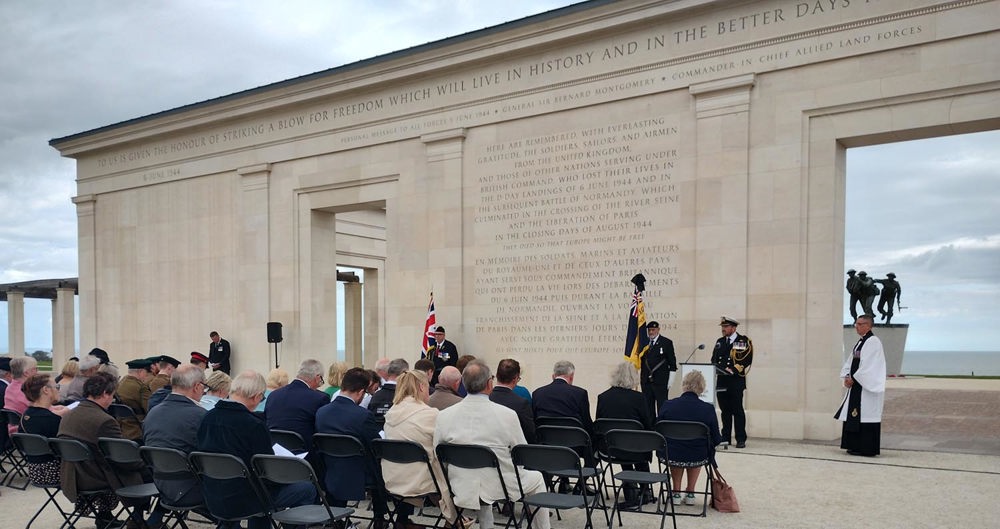
The Rev Paul Collins CF conducts a commemorative service for all five soldiers at the British Normandy Memorial. (Photo: Crown Copyright)
The graves of five soldiers who went missing during the Battle of Normandy have been identified and were rededicated at ceremonies on the 29, 30 September and 1 October 2026.
A commemorative service honouring all five men, was also held at the British Normandy Memorial in Ver-sur-Mer on 30 September 2026.
Rededication services took place on 29 September 2026 at the CWGC St Charles-de-Percy War Cemetery for Private (Pte) George Chapman of 1st Battalion The Herefordshire Regiment. At CWGC Bayeux War Cemetery on 30 September 2026 for Private Vincent Coia of 7th Battalion The Seaforth Highlanders and Lance Corporal (LCpl) Reginald Cyril Dewey of 4th Battalion The Lincolnshire Regiment. At CWGC Hottot-les-Bagues War Cemetery on 1 October 2026 for Serjeant (Sjt) Frederick Albert Harrison of 1st Battalion The Dorsetshire Regiment and at CWGC Ranville War Cemetery for Corporal (Cpl) Henry Thomas Read of 8th Battalion The Rifle Brigade on the same day.
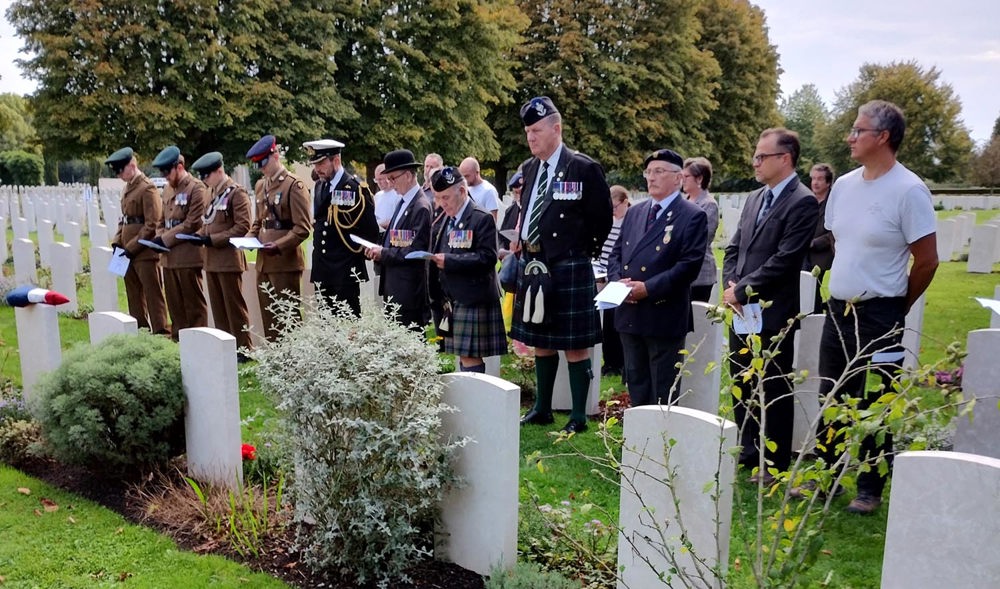
The rededication service for Private Coia takes place in Bayeux War Cemetery. (Photo: Crown Copyright)
Members of the Chapman, Dewey and Read families were present at their relatives’ rededication service. The Coia and Harrison families were not able to attend, but a poignant message from Reg Harrison, the 95 year old younger brother of Sjt Harrison, was read out at his graveside in Hottot-les-Bagues War Cemetery. The message read: “Although I didn't know my brother very well, as I was only young when he left home to join the army, I'm very proud of him and what he achieved, and what he went onto do for his King and country. It was soldiers like Fred that helped us win the war, and keep us safe. Always in my thoughts. Your young brother, Reg. X”
The services were organised by the Ministry of Defence's Joint Casualty and Compassionate Centre (JCCC) and were supported by serving soldiers from 5th Battalion The Rifles, 2nd Battalion The Royal Anglian Regiment and 2nd Battalion The Royal Regiment of Scotland.
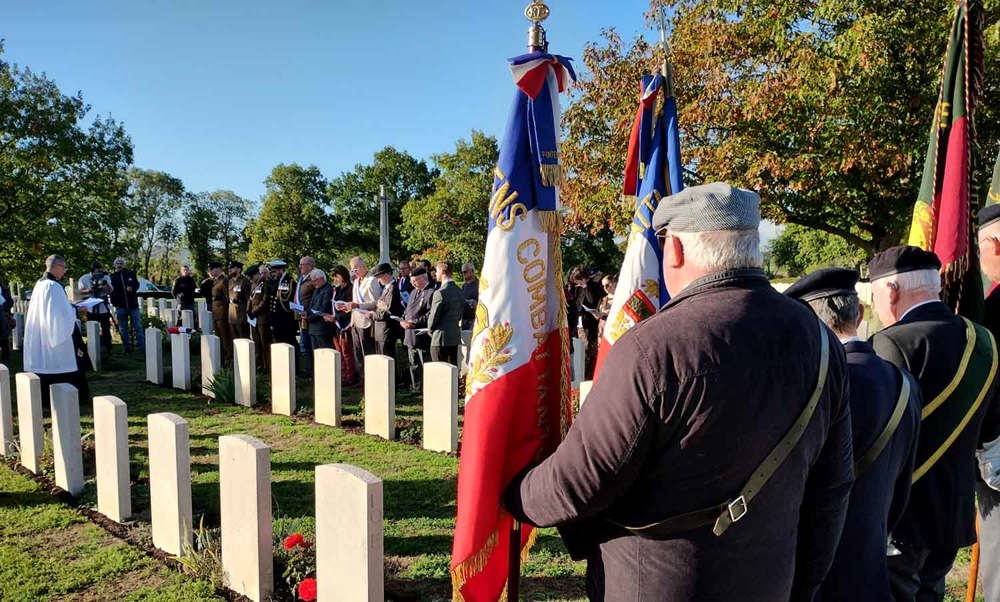
The rededication service for Serjeant Harrison takes place in Hottot-les-Bagues War Cemetery. (Photo: Crown Copyright)
Rosie Barron, JCCC Caseworker, said: "It has been an honour to have organised these rededication services and to have played a part in giving these families answers as to what happened to their relatives. The local community in Normandy has been very welcoming of both the families and the military party. For them the Battle of Normandy is not just commemorated but celebrated as the moment that they regained their liberty after four long years of occupation. The sacrifices made by these men were not in vain. There are many graves in Normandy which may yet be identifiable with further investigation, so this work will continue into the future.”
Reverend Paul Collins CF, Chaplain to 5th Battalion The Rifles, conducted the services.
Reverend Paul Collins said: “It is my privilege to be able part of these rededication services. These brave soldiers gave their lives in the events following D-Day which led to the liberation of France and the defeat of the Nazis. It is fitting that due to the hard work of the JCCC Commemorations Team and others, we now know who these soldiers were and where they are buried. The graves now bear their names for all those who visit in the future to see and remember.”
All five men had previously been commemorated on the Bayeux Memorial to the missing. The CWGC has now replaced their headstones with named markers and will care for them in perpetuity.
Dr James Wallis, CWGC Head of Commemorations, said: “The Commission’s staff consider it a privilege to care for the now-identified graves of these five soldiers who were killed in the aftermath of D-Day during the Battle of Normandy. The impact of loss upon the respective families of these casualties still resonates strongly – so we are thankful to those who instigated each identification and furthermore to the work of partner organisations which has led to this outcome and brought us together today.”
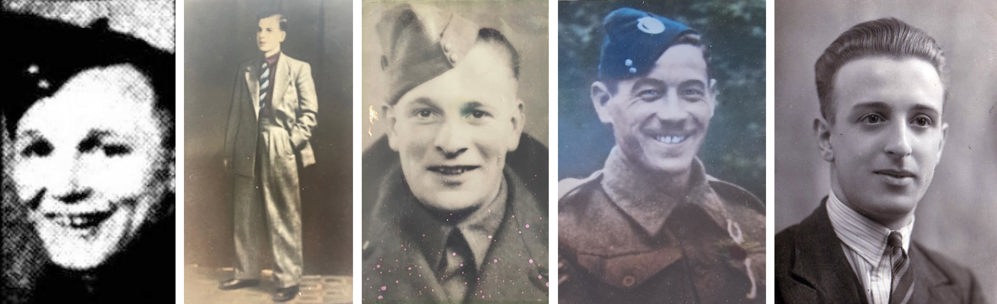
Left to right: Private George Chapman (copyright unknown), Private Vincent Coia (courtesy of the Coia family), Lance Corporal Reginald Cyril Dewey (courtesy of the Dewey family), Serjeant Frederick Albert Harrison (courtesy of the Harrison family), Corporal Henry Thomas Read (courtesy of the Read family).
Private George Chapman
George Chapman was born on 27 March 1920 in Stoke-on-Trent, Staffordshire. Before enlisting into the Army on 30 May 1940, he worked as a letter press mender. Pte Chapman embarked for Normandy on 27 June 1944 and on 20 July 1944 was posted to 1st Battalion The Herefordshire Regiment. On 30 July 1944 the battalion attacked as part of Operation Bluecoat. Pte Chapman was killed that day near Caumont-sur-Aure. He was 24 years old.
Private Vincent Coia
Vincent Coia was born Vincenzo Coia, on 20 March 1925 in Glasgow, Scotland, to Italian parents. Before enlisting into the Army on 18 November 1943, Vincenzo worked as a shop assistant. Pte Coia arrived in Normandy on 23 June 1944 and was posted to 7th Battalion The Seaforth Highlanders on 30 June 1944. On 11 July 1944 the battalion took part in Operation Jupiter, the aim of which was to seize the high ground of Hill 112. The battalion was ordered to capture the Le Mesnil to Eterville Road. Pte Coia was killed during the attack. He was 19 years old.
Lance Corporal Reginald Cyril Dewey
Reginald Cyril Dewey was born on 15 July 1918 in Bourne, Lincolnshire. On 12 July 1939 Reginald married Vera Molsher. Their daughter Janet Delores was born the following year. Just three days after his marriage, Reginald enlisted into the Army on 15 July 1939, his 21st Birthday. Reginald was posted to 4th Battalion The Lincolnshire Regiment and was stationed in Norway between April and May 1940. On 22 June 1940 the battalion was posted to Iceland for garrison duty for the next two years. He was promoted to lance corporal on 11 April 1941. On 9 June 1944, 4th Battalion The Lincolnshire Regiment sailed for Normandy. On the morning of 1 July 1944 the battalion was at Tessel Bretteville when the Germans launched an attack aiming to cut off the bridgehead over the River Odon. The attack was ultimately held off, but LCpl Dewey was killed during the attack. He was 26 years old.
Serjeant Frederick Albert Harrison
Frederick Albert Harrison was born in 1917 in Stamford, Lincolnshire. Before enlisting into the Army on 20 September 1934, he worked as a gardener. He enlisted under the alias of Frederick Albert Smith and was posted to 1st Battalion The Dorsetshire Regiment on 17 March 1936, when he embarked for service in India. On 17 June 1939 he embarked for Malta where 1st Battalion The Dorsetshire Regiment was on garrison duty. The battalion saw action in North Africa, Sicily and Italy before returning to the United Kingdom. Whilst home, the then Cpl Harrison married Florence Freear in East Ham, Essex, on 13 May 1944. On 6 June 1944, D Day, 1st Battalion The Dorsetshire Regiment took part in Operation Overlord, landing on Gold Beach. The battalion lost two Serjeants that day and Cpl Harrison was made an unpaid acting Serjeant in the field. On 19 June 1944, the battalion moved to Point 113 before making an attack on the wood around the Chateau de Cordillon. Sjt Harrison was killed that day. He was 27 years old.
Corporal Henry Thomas Read
Henry Thomas Read was born on 30 June 1916 in Poplar, London. Henry worked as a clerk in civilian life and on 4 April 1939 joined 2nd Battalion The London Rifle Brigade, a territorial battalion. He was embodied on 1 September 1939 shortly before the outbreak of war. On 6 April 1940 he married Irene May Smith in Barnet, Middlesex. Their son Anthony David was born in 1944. 2nd Battalion The London Rifle Brigade was retitled 8th Battalion The Rifle Brigade and became a motorised battalion. The then Rifleman Read trained as a driver operator. The battalion disembarked at Juno Beach on 13 June 1944. Rifleman Read was promoted straight to Corporal on 29 June 1944. On 18 July 1944 the battalion took part in Operation Goodwood. Cpl Read is recorded as having been wounded at Hubert-Folie that day and as having died from his wounds. He was 28 years old.