
17 August 2026
A Guide's Guide to Reconstructing Loss Through Poetry
Poetry, literature and the World Wars are closely linked, particularly the war poetry of the First World War.
Here, CWGF Guide Severine examines how poetry, loss and commemoration mix to help us better understand the experiences of Commonwealth soldiers of the Great War.
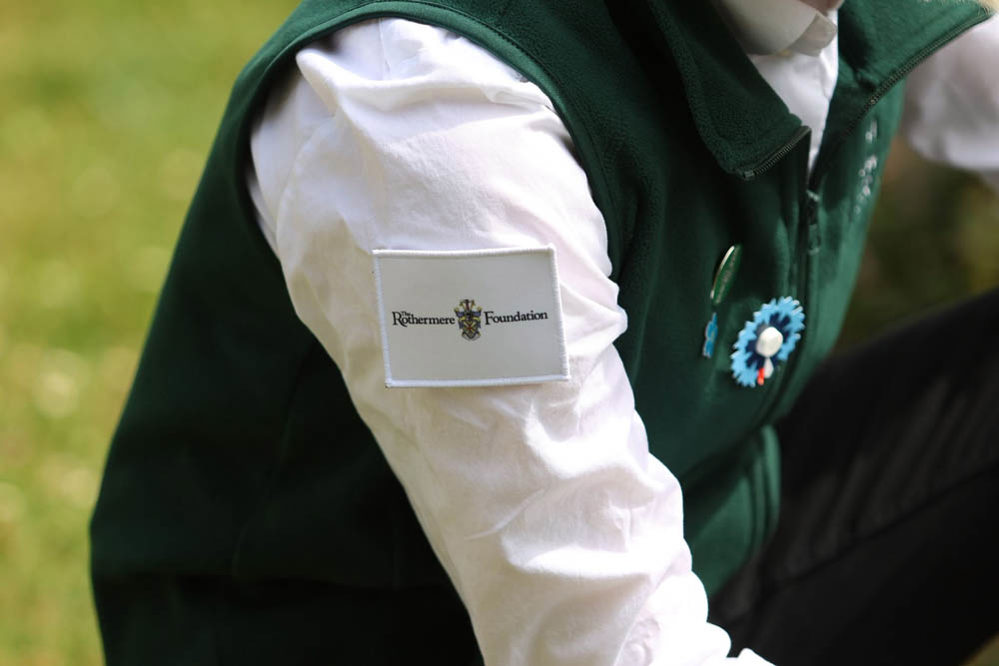
Image: Severine is The Rothermere Foundation Guide for 2026 (Emma Montreuil)
Severine is The Rothermere Foundation Guide for this year's cohort. We are extremely grateful to The Rothermere Foundation for sponsoring Severine to become a Guide and for their incredible generosity.
Over to Severine.
Poetry, loss and commemoration
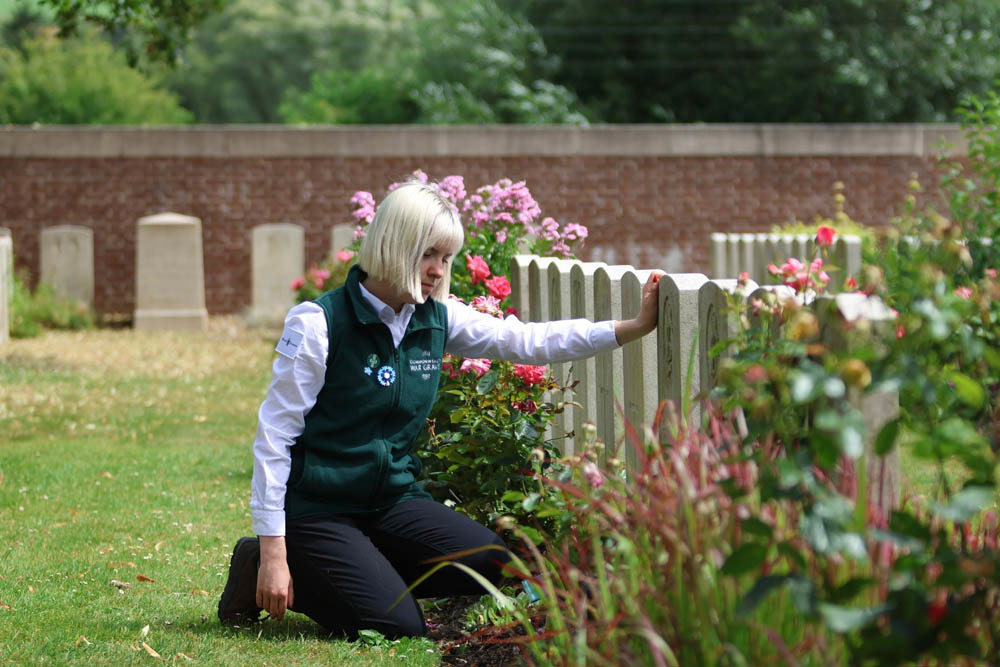
Image: Severine paying her respects at a CWGC war grave (Emma Montreuil)
Literature is one of the most crucial resources available to us when constructing personal accounts of the Battle of the Somme.
In particular, the poetic form was one that many soldiers, such as Wilfred Owen, Siegfried Sassoon, and Alan Patrick Herbert, found comfort in using.
Poetry helped them articulate their experiences in the trenches, express grief, and convey the extent of human loss to which the Commonwealth regiments were subject.
Beaucourt Revisited
One of the best-known examples of this is A.P. Herbert’s Beaucourt Revisited:
I wandered up to Beaucourt; I took the river track
And saw the lines we lived in before the Boche went back;
But Peace was now in Pottage, the front was far ahead,
The front had journeyed Eastward, and only left the dead.
And I thought, how long we lay there, and watched across the wire,
While guns roared round the valley, and set the skies afire!
But now there are homes in Hamel and tents in the Vale of Hell,
And a camp at suicide corner, where half a regiment fell.
The new troops follow after, and tread the land we won,
To them 'tis so much hill-side re-wrested from the Hun
We only walk with reverence this sullen mile of mud
The shell-holes hold our history, and half of them our blood.
Here, at the head of Peche Street, 'twas death to show your face,
To me it seemed like magic to linger in the place;
For me how many spirits hung around the Kentish Caves,
But the new men see no spirits - they only see the graves.
I found the half-dug ditches we fashioned for the fight,
We lost a score of men there-young James was killed that night,
I saw the star shells staring, I heard the bullets hail,
But the new troops pass unheeding-they never heard the tale.
I crossed the blood red ribbon, that once was no-man's land,
I saw a misty daybreak and a creeping minute-hand;
And here the lads went over, and there was Harmsworth shot,
And here was William lying-but the new men know them not.
And I said, "There is still the river, and still the stiff, stark trees,
To treasure here our story, but there are only these";
But under the white wood crosses the dead men answered low,
"The new men know not Beaucourt, but we are here-we know."
In this month alone, the Royal Naval Division (to which the Hawkes belonged) suffered 4,000 wounded and killed. Such was the scale of loss that after the first day of the attack, the battalion's war diary recorded that Herbert's battalion within “the first few minutes… no longer existed as a unit.”
These extensive losses are immortalised within the poem's lines, even if, as Herbert himself writes, they were already fading from living memory by February 1917, barely three months later.
“The new men know not Beaucourt”, our narrator bemoans of his new companions. Yet through the poetic medium, he forces them and the reader to bear witness to the extensive casualties which resulted from the battle.
The real men behind the poem
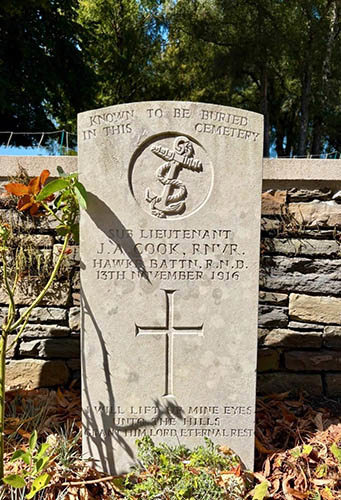 Image: Special Memorial to Sub-Lieutenant James Archibald Cook
However, the most striking evocation of loss stems from the poet's recollection of his friend's demise. Herbert asks his readers to acknowledge the loss of James, Harmsworth and Ker.
These names refer to Lieutenants Vere Sidney Tudor Harmsworth and William Ker, who were respectively 21 and 24 years old at the time of their deaths, whilst “Young James” is believed to be Sub-Lieutenant James Archibald Cook.
This decision to include the losses he was most personally impacted by illustrates the author's desperation for remembrance, whilst simultaneously serving as a stark reminder of the thousands of brilliant young minds lost to the First World War.
It becomes more saddening, still, when juxtaposed with the incomprehension of the next wave of soldiers who, upon arriving in the area, “only see the graves” without, as Herbert alludes, truly connecting them to the extent of human loss that they themselves are about to undergo.
Why is war poetry important?
Personal, poetic, and literary narratives are all ways in which soldiers communicated their experiences of the First World War.
They not only help us to identify casualties through their recollection of specific people's names and locations, but are also a central aspect of commemoration.
Many soldiers did this themselves through both oral and written tradition.
However, as accounts of the First World War drift further away from living memory, the onus of this task has shifted to the families of those affected, as well as to the Commonwealth War Graves Commission, which seeks to do so through:
- The installation and upkeep of headstones, cemeteries and memorials
- Reburial ceremonies which commemorate the fallen with full military honours
- Creating a digital archive of personal stories through our online portal, where members of the public can freely upload the stories passed down to them
- Through the Guides Programme, which I have the privilege to participate in this year
Moreover, poems such as this one serve as enduring warnings of the devastating human consequences of warfare.
Even those fortunate enough to return home alive were left irreparably scarred, something foreseen by Harmsworth, who wrote in a letter to his uncle days before his death: “in the years to come, I shall never be any good. When attending to one thing my mind will be elsewhere”.
This seems true in regard to Herbert, who was one of only two Hawke Battalion officers to emerge physically unscathed from the Battle of the Ancre, yet dedicated the remainder of his life to writing works which centred around his experiences of the war, such as The Secret Battle (1919).
Consequently, this highlights the reasons why keeping these accounts in circulation is so fundamental to understanding the human impact of the First World War, and why drawing comparisons between them and the historical figures they address remains important.
Commemorating the men of Beaucourt Revisited
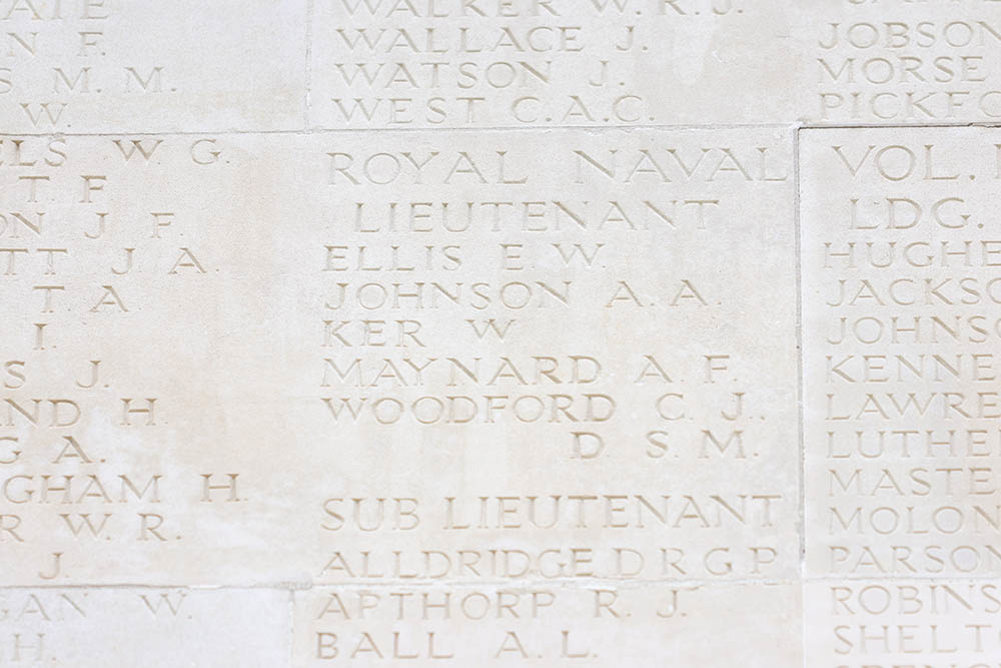
Image: William Ker's name on the Thiepval Memorial
Visitors may pay their respects to both William and James, the former of whom is commemorated on Pier & Face 1A of the Thiepval Memorial and the latter at Y Ravine Cemetery in Beaumont Hamel, whilst Harmsworth is commemorated in Ancre British Cemetery.
In our first week of training, this year's cohort of CWGC guides paid a visit to Ancre, where we reread Beaucourt Revisited at Harmsworth’s headstone.
Having a tangible monument to connect Herbert's poem to gave me a much greater sense of the personal impact of war on the survivors who lost their friends and family between 1914 and 1918.
What's more, after spending June and July working at Thiepval, I can’t help but agree with Herbert’s proclamation that “To me it seemed like magic to linger in this place”, watching families, tourists and schoolchildren pass sunny afternoons in the same place where so many men lost their lives 110 years ago.
Our Guides rely on your support. Donate today
The Commonwealth War Graves Foundation Guides Programme allows young history lovers to work for Commonwealth War Graves in France and Belgium.
They welcome visitors, share the incredible stories of those commemorated by Commonwealth War Graves, and assist our guests on their journey of remembrance at important sites on the Western Front.
We’re passionate about preserving the memories of the Commonwealth’s war dead and interacting with young people to keep their stories alive. Our Guides help us in our core mission while becoming equipped with real-life skills to aid their personal development.
Our Guides Programme relies on your generosity.
£100 could pay to fully train one of our Guides ready for their experience of working abroad so they are best able to welcome visitors, share the incredible stories of those we commemorate, and help assist visitors on their journey of remembrance.
Please donate to the Commonwealth War Graves Foundation today to keep projects like this going.
Donate Online Now
By donating to the Commonwealth War Graves Foundation, you are helping us to keep the stories of the brave servicemen and women who died in the two World Wars alive. Can you help us ensure that their sacrifice is not forgotten?

Your donation enables us to continue sharing the inspiring stories of those like Ensign Violette Szabo, a brave SOE operative and spy who was executed in Ravensbrück concentration camp and posthumously awarded the George Cross. Violette is commemorated at our Brookwood Memorial.